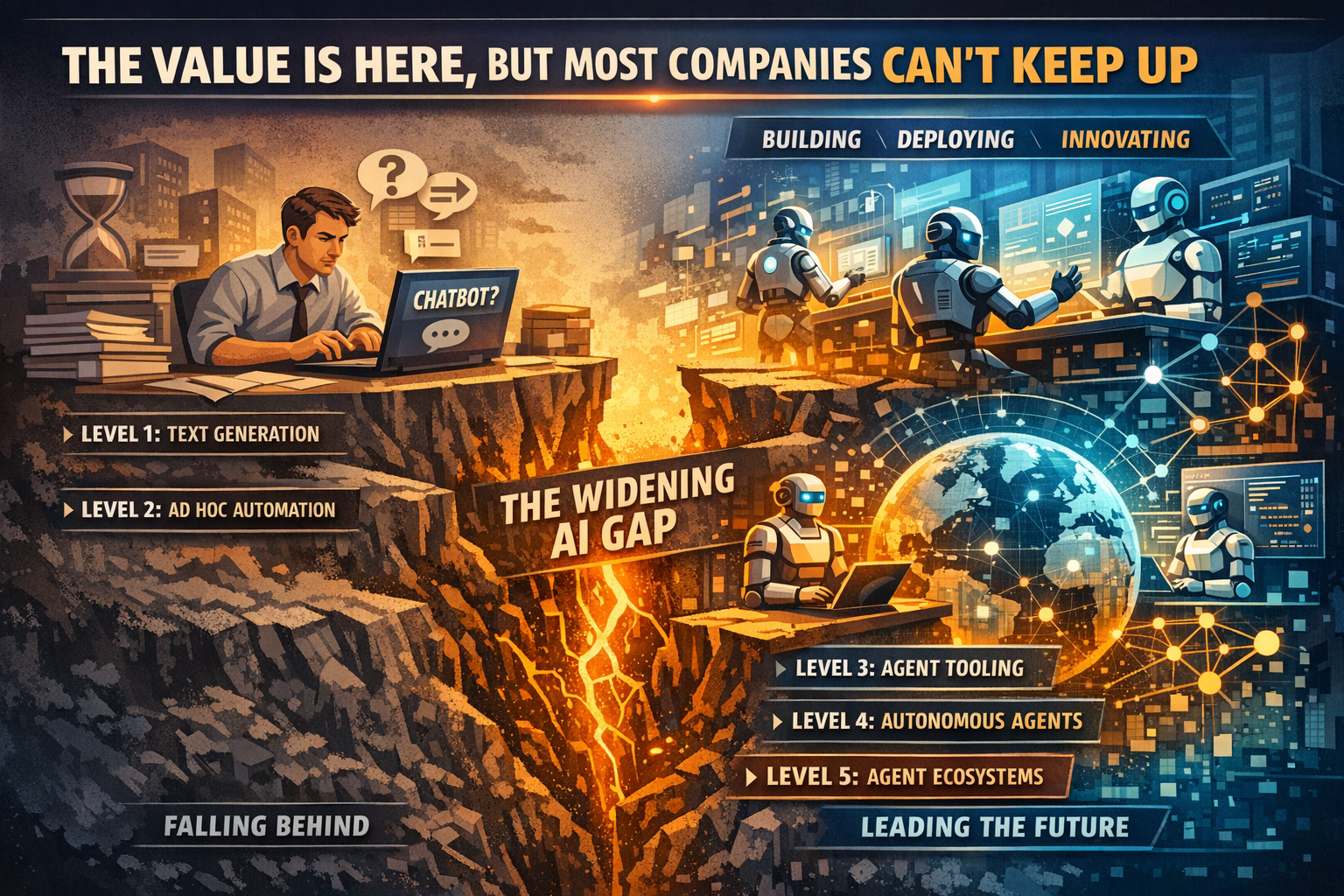
AI stopped being a novelty in 2024. In 2026, it is infrastructure. If your organization still treats it like a chatbot, you are operating on a two-year delay in a field where breakthroughs are measured in weeks.
The Accessibility Paradox
Here is the counterintuitive truth about modern AI: it is simultaneously the most powerful and the most accessible technology in the enterprise stack. A non-technical business leader can use plain language to instruct an AI agent to build a working dashboard, draft a contract, analyze a quarter's worth of financial data, or scaffold an internal tool, all in minutes, without writing a single line of code.
No enterprise software category in history has offered this combination of depth and accessibility. Not ERP systems. Not business intelligence platforms. Not low-code tools. AI is inherently accessible because its interface is human language.
And yet, most organizations are barely scratching the surface. The majority of companies today use AI the way they used Google in 2005: as an information retrieval tool. They type a question into ChatGPT or Microsoft 365 Copilot, get a text response, and move on. That interaction model - ask a question, receive text - represents 2023-era AI. We are now three generations of capability beyond that.
The gap between what AI can do and what most companies are doing with it is not incremental. It is structural. And it is widening.
A Brief History of How We Got Here (And Why It Matters)
The research trajectory of AI is not academic trivia. It is a leading indicator. What appears in research papers today becomes production technology 12 to 18 months later. Understanding this pipeline is how leaders anticipate where to invest, rather than perpetually reacting.
2020: Retrieval-Augmented Generation (RAG)
In 2020, researchers at Meta AI published Retrieval-Augmented Generation for Knowledge-Intensive NLP Tasks, introducing a method for combining a language model's generative capabilities with a real-time retrieval mechanism that pulls from external knowledge sources (Lewis et al., NeurIPS 2020). In practical terms, this meant AI systems could access and reason over your specific company data - documents, databases, internal knowledge bases - rather than relying solely on what was baked into the model during training.
It took until 2023–2024 for enterprises to widely adopt RAG architectures. The research was published four years before the market caught up. That lag is the pattern to watch.
2023: Generative Agents and the Emergence of Autonomous Behavior
Stanford researchers published Generative Agents: Interactive Simulacra of Human Behavior, a landmark study in which 25 AI agents inhabited a virtual town, maintained jobs, formed relationships, planned their days, and coordinated social events, all autonomously (Park et al., UIST 2023). No human directed their actions. Given only a brief identity description, the agents independently organized a Valentine's Day party, spread invitations through social networks, and showed up at the right time.
This was not a product demo. It was a proof of concept that AI agents could operate with sustained autonomy, memory, and social coordination. It laid the conceptual foundation for the agentic AI systems now entering production.
2024: The Model Context Protocol (MCP): An App Store for Agents
In November 2024, Anthropic open-sourced the Model Context Protocol (MCP), a universal standard for connecting AI systems to external data sources and tools. MCP solved a critical bottleneck: every new data integration previously required custom engineering. MCP replaced fragmented, one-off connectors with a single protocol, effectively creating an ecosystem where agents can plug into enterprise tools (Jira, Slack, GitHub, Notion, databases, and hundreds more) the way apps plug into a smartphone.
Adoption was immediate. Microsoft, Google, Block, Replit, Sourcegraph, and virtually every major SaaS platform now support MCP. The infrastructure for agent tooling is no longer theoretical. It is deployed, standardized, and growing.
2025: The Agent2Agent Protocol (A2A): Agents Talking to Agents
Google published the Agent2Agent Protocol (A2A), an open standard for autonomous agents to discover, communicate, and collaborate with other agents across organizational boundaries. Where MCP connects agents to tools, A2A connects agents to each other.
This is the architectural equivalent of HTTP for the agent era. Just as the early internet required standardized protocols so that any browser could talk to any server, the emerging agent ecosystem requires standardized protocols so that any agent can negotiate, delegate, and transact with any other agent, securely and at scale.
The implications are significant. As cybersecurity leader Darren Shelcusky articulated in his analysis The Internet of Agents (February 2026): "A new architectural model is emerging in which autonomous AI agents act as first-class participants on the internet. Rather than humans interacting directly with applications, AI agents operate on behalf of individuals and companies." He describes a shift from session-based, user-driven workflows to continuous, goal-driven autonomous execution, where agents dynamically discover APIs, chain services together, reason over outcomes, and coordinate task handoffs with peer agents.
2026: Secure Autonomous Deployment
The final barrier, secure deployment of autonomous agents at enterprise scale - is actively being resolved. NVIDIA released NemoClaw, an open-source framework for securely deploying autonomous AI agents. AWS published a reference architecture for deploying autonomous agents on cloud infrastructure with proper security boundaries. The Cyber Strategy Institute released the AI SAFE2 Framework for governing AI deployments.
These are not research papers. They are production-ready repositories, published within the last 60 days. The infrastructure, security tooling, and governance frameworks for autonomous AI are arriving simultaneously.
Where Most Companies Are, And What They're Missing
Most organizations fall into one of these categories:
Level 1: Text Generation (2023): Using ChatGPT, Copilot, or similar tools as conversational assistants. Asking questions, generating drafts, summarizing documents. This is valuable, but it is fundamentally information retrieval with better formatting. Using AI at this level is the equivalent of using the internet only for email.
Level 2: Ad Hoc Automation (2024): Using tools like Zapier or basic workflow automations to connect AI to a few business processes. Useful, but fragmented and unscalable. No governance, no architecture, no compounding returns.
Level 3: Agent Tooling and Coding Agents (2025): Deploying AI agents that can execute multi-step tasks: writing and running code, interacting with databases, managing deployments, building internal tools on demand. These agents don't just answer questions; they do work. Integrated through MCP, they connect to your company's actual systems and operate on your real data.
Level 4: Autonomous Agents (2026): Deploying always-on agents scoped to departments or functions (finance, HR, operations, engineering) that continuously execute against defined objectives. These agents don't wait for prompts. They monitor, act, report, and adapt. Securely deployed on enterprise infrastructure with proper governance and audit trails.
Level 5: Agent-to-Agent Ecosystems (Emerging): Multiple autonomous agents across departments and partner organizations communicating via standardized protocols, negotiating resource allocation, coordinating cross-functional workflows, and executing transactions, all without human intervention for routine operations.
If your organization is operating at Level 1 or 2, you are using 2023 technology in 2026. The distance between Level 1 and Level 3 is not a minor upgrade. It is the difference between a 1.5x productivity improvement and a 10x one. And that gap compounds daily.
The SaaS Model Is Dissolving for AI-Literate Organizations
Here is something most leaders haven't internalized: modern AI tools can generate custom software on demand.
Need a tool that reads all your customer support emails, categorizes them by urgency and topic, and produces a weekly executive summary? In 2023, you would search for a SaaS product, evaluate vendors, negotiate contracts, and onboard a platform. In 2026, you describe what you need in plain language and an AI agent builds it for you, often in under an hour.
This doesn't mean SaaS is dead. But it means AI-literate companies are no longer dependent on external software for a growing category of internal tooling needs. They create bespoke solutions tailored to their specific data and workflows, at a fraction of the cost and timeline. Companies doing this are generating $10,000-per-month value from tools that cost pennies to run.
The key enabler is data. The more structured and accessible your company's data is, the more value AI can generate from it. Meeting notes, customer interactions, financial records, project documentation, operational metrics, every data source you make available to your AI systems multiplies their utility. Data is the bottleneck, and it is also the multiplier.
Why AI Governance Is Not Optional: It's the Accelerant
This is the part that surprises most leaders: governance and infrastructure are not the brakes on AI adoption. They are the accelerator.
The instinct, especially among fast-moving, entrepreneurial organizations, is to view governance as overhead. Something for heavily regulated Fortune 500 companies. Not for us. We're agile. We move fast.
That instinct is wrong, and here's why.
The Standards Are Clear
ISO 42001 (published 2023) established the international standard for AI Management Systems. It explicitly calls for designated AI leadership, centralized AI governance, and systematic risk management, proportionate to the organization's size and AI exposure. This is not a suggestion. It is the international standard that auditors, partners, and regulators are increasingly referencing.
The NIST AI Risk Management Framework (AI RMF) provides a structured approach to identifying, assessing, and mitigating AI risks across the lifecycle, from design through deployment and monitoring. It emphasizes that organizations need dedicated AI leadership roles and cross-functional governance structures.
Both frameworks share a core premise: AI requires the same organizational discipline as cybersecurity or IT infrastructure. You would never deploy production IT systems without security policies, access controls, incident response plans, and designated leadership. AI demands the same treatment, because the attack surface, compliance exposure, and operational risk are comparable.
Governance Enables Speed
Without governance and infrastructure:
- You deploy AI tools ad hoc, with no security posture, no audit trail, and no scalability
- You accumulate technical debt that makes future adoption harder, not easier
- You expose your organization to prompt injection attacks, data leakage, and compliance violations
- You cannot adopt new capabilities (like autonomous agents) when they become available because you have no foundation to build on
With governance and infrastructure:
- You can evaluate and deploy new AI capabilities rapidly because the guardrails already exist
- You can scale from a single use case to organization-wide deployment without rebuilding from scratch
- You are prepared when NVIDIA drops a secure autonomous agent framework, because you already have the governance posture to evaluate and adopt it
- Your AI investments compound because they build on a coherent architecture rather than isolated experiments
The companies that will lead in the next 24 months are not the ones that experimented the most. They are the ones that built the foundation to scale what works.
The Compounding Advantage
Consider this scenario: Your competitor has deployed coding agents integrated with their development pipeline, autonomous monitoring agents for their operations, and AI-assisted analysis across their business intelligence stack. They are generating custom internal tools weekly. Their teams are operating at 5–10x the productivity of manual workflows across digital tasks.
That advantage is not static. It compounds. Every week, they are:
- Shipping faster
- Making better-informed decisions with more data analysis
- Iterating on products more rapidly
- Reducing operational overhead
- Freeing human talent for high-judgment, creative, and strategic work
Meanwhile, an organization still at the chatbot level is improving linearly, if at all. The gap doesn't close over time. It widens. And unlike previous technology adoption cycles, the cost of entry is remarkably low. Running AI agents is comparable to running a cloud server. The barrier is not budget. It is awareness and infrastructure.
Any digital task currently performed by a human can likely benefit from agentic automation. That is not a speculative claim. It is the operational reality for organizations that have made the transition.
The Future Outlook: Prepare Now or React Later
The trajectory is clear:
Near-term (2026–2027): Agent tooling and MCP-connected systems become table stakes for competitive organizations. Companies without AI governance frameworks will struggle to adopt securely and will face increasing regulatory scrutiny.
Medium-term (2027–2028): Agent-to-agent ecosystems (A2A) mature. Autonomous agents begin transacting across organizational boundaries, negotiating with vendor agents, coordinating with partner systems, executing routine business processes end-to-end. Organizations with strong data infrastructure and governance will adopt these capabilities seamlessly. Others will be locked out by their own technical debt.
Long-term (2028–2030+): AI agents become embedded economic actors, managing budgets, executing transactions, and operating as continuous participants in digital commerce. The "Internet of Agents" that Shelcusky describes becomes operational reality, requiring enterprise-grade identity management, intent-based authorization, and adaptive security controls for non-human actors.
The organizations that build governance frameworks, modernize their data infrastructure, and designate AI leadership today are not just solving today's problems. They are positioning themselves to adopt each successive wave of capability without starting from zero.
The Path Forward
The message is straightforward:
- Recognize the gap. If your organization's AI strategy begins and ends with text-based chatbots, you are operating on 2023 assumptions. The technology has moved. Your strategy must move with it.
- Designate AI leadership. ISO 42001 and the NIST AI RMF both call for this. AI cannot be an ad hoc initiative distributed across departments with no central ownership. It requires dedicated leadership the same way cybersecurity and IT infrastructure do.
- Establish governance and infrastructure. Start with a risk assessment. Understand your organization's AI maturity, identify gaps, and build a governance framework proportionate to your size and exposure. This is the foundation that makes everything else possible.
- Modernize your data. The value AI generates is directly proportional to the data it can access. Centralize, structure, and make your organizational data available for AI systems: meeting notes, documentation, operational data, customer interactions. Data is the multiplier.
- Move beyond text generation. Deploy agent tooling. Connect AI to your actual business systems through MCP. Start with high-value, well-scoped use cases and expand from a governed foundation.
- Build for what's coming. The agent-to-agent future is not speculative. The protocols are published, the infrastructure is being deployed, and the security frameworks are arriving. Organizations with strong foundations will adopt these capabilities naturally. Those without will scramble.
The technology is here. The protocols are standardized. The security tooling is maturing. The cost is minimal. The only remaining variable is whether your organization has the awareness and the infrastructure to capture the value.
Two years behind in AI, given the current rate of advancement, is a generational gap. The question is not whether to act, but how quickly you can close the distance.
References
- Lewis, P., Perez, E., Piktus, A., et al. "Retrieval-Augmented Generation for Knowledge-Intensive NLP Tasks." 34th Conference on Neural Information Processing Systems (NeurIPS 2020), Vancouver, Canada. Facebook AI Research / University College London / New York University.
- Park, J.S., O'Brien, J.C., Cai, C.J., et al. "Generative Agents: Interactive Simulacra of Human Behavior." 36th Annual ACM Symposium on User Interface Software and Technology (UIST 2023), San Francisco, CA. Stanford University / Google Research / Google DeepMind.
- Anthropic. "Introducing the Model Context Protocol." November 25, 2024.
- Google. "Announcing the Agent2Agent Protocol (A2A)." Google Developers Blog, 2025.
- Shelcusky, D. "The Internet of Agents." February 12, 2026. Cyvantis LLC.
- ISO/IEC 42001:2023. "Information technology: Artificial intelligence: Management system." International Organization for Standardization.
- National Institute of Standards and Technology. "AI Risk Management Framework (AI RMF 1.0)." January 2023. U.S. Department of Commerce.
- AWS Samples. "Sample-OpenClaw-on-AWS-with-Bedrock."
- NVIDIA. "NemoClaw."
- Cyber Strategy Institute. "AI SAFE2 Framework."
Rodney Brown is the founder of DevPro LLC, an AI governance consulting practice specializing in helping organizations modernize their AI infrastructure and governance posture. DevPro's AI Atlas platform provides risk diagnostic assessments aligned with ISO 42001, the NIST AI RMF, and the MIT AI Risk Repository, helping companies at every stage identify gaps and build the foundation for scalable, secure AI adoption.